

Excerpt from Northcote Thomas's Anthropological Report on Ibo-speaking Peoples of Nigeria
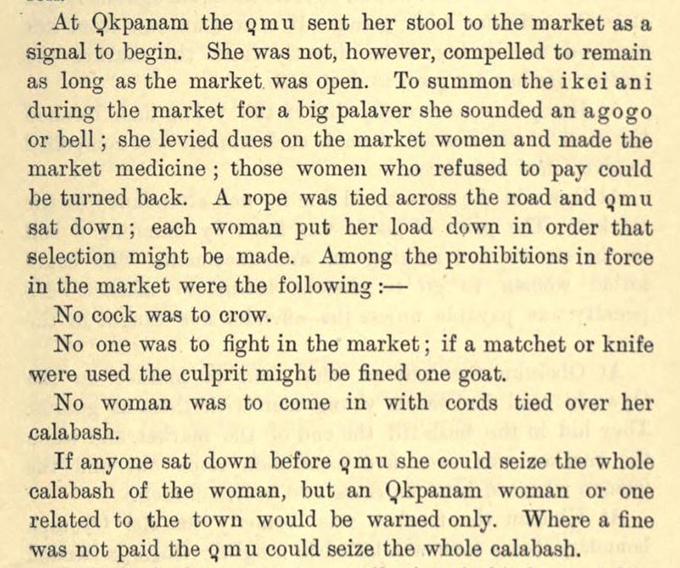
A photograph depicting a printed textual fragment from Northcote Thomas's Anthropological Report on Ibo-speaking Peoples of Nigeria, Part IV, Law and Custom of the Ibo of the Asaba District, S. Nigeria, page 189. The text documents the localized governance system in Okpanam, specifically the role of the 'qmu' (Omu), who acts as the market queen. Her regulatory powers include using a stool as a signal to commence market activities, utilizing an 'agogo' (bell) to summon the 'ikei ani' for significant matters, and levying dues on market women. The document also lists behavioral prohibitions, such as the prohibition of fighting and the rules regarding seating priority, where individuals are forbidden from sitting before the Omu.
Community Notes

Onyeka Nwokike
Oct 17, 2026
Titled Omu in the Anioma nation serve as spiritual protectors to the Obi (king) and exercise authority over market prices and shrines, according to The Omu of Okpanam – Afro-Global Education Deliveries and Omu and the red cap controversy in Okpanam - [Re:]Entanglements.
Onyeka Nwokike
Oct 17, 2026
During his September 1912 visit to Okpanam, Northcote Thomas captured approximately 30 photographs, including a portrait of the Omu (photograph no. 4108). This image depicts the Omu with nzu (kaolin chalk) marks on her forehead and around her eyes, wearing an assortment of bead and shell necklaces and a cap adorned with feathers and small triangular blades (Omu and the red cap controversy in Okpanam - [Re:]Entanglements).
Onyeka Nwokike
Oct 17, 2026
The okpu ododo (red cap of office) is the subject of ongoing political disputes in Okpanam regarding who is entitled to wear it. This symbol of authority was used by senior title holders and warrant chiefs during the colonial era (Omu and the red cap controversy in Okpanam - [Re:]Entanglements), while more recent administrative developments include the 2004 introduction of the Ugoani post to represent the Diokpa-Isi and Izu Ani (General Assembly).
Log in to add context.
Explore Further
Discover related books and stories to deepen your understanding.

Anthropological Report on the Ibo-Speaking Peoples of Nigeria: Law and …
By Northcote Thomas

Anthropological Report on the Ibo-Speaking Peoples of Nigeria, Vol. 2: …
By Northcote Thomas

Anthropological Report On The Ibo-speaking Peoples Of Nigeria, Part 6 …
By Northcote Thomas

Igbo market literature
By Sebastian Okechukwu Mezu

The Asaba Massacre: Trauma, Memory, and the Nigerian Civil War
By S. Elizabeth Bird and Fraser M. Ottanelli

The King in Every Man: Evolutionary Trends in Onitsha Ibo …
By Richard N. Henderson

Ohaffia: A Matrilineal Ibo People
By Philip O. Nsugbe

An African Popular Literature: A Study of Onitsha Market Pamphlets
By Emmanuel N. Obiechina

An Introduction to Nigerian Traditional Architecture: South-Eastern Nigeria: The Igbo-speaking …
By Z.R. Dmochowski
You May Also Like
Portrait of a Woman along the Niger River
By William Henry Crosse
Portrait of Chief William Brown's Daughter
By J.A. Green
Excerpt from Anthropological Report on the Ibo-speaking Peoples of Nigeria
By Northcote Thomas
Mural Decorations in Nri Akwa
By G.I. Jones
Portable Household Shrine, North Ika
By G.I. Jones
Royal Niger Company Constabulary Band
By William Henry Crosse
Portrait of a Woman Seated on a Bentwood Chair
By William Henry Crosse
Ogbugulu Mau Masquerader Performing in Amuda Village
By G.I. Jones
Young Igbo Girl Painted with Uli
By Sylvia Leith-Ross
No comments yet. Be the first to share your thoughts!