

Nigerian String Games Album Page
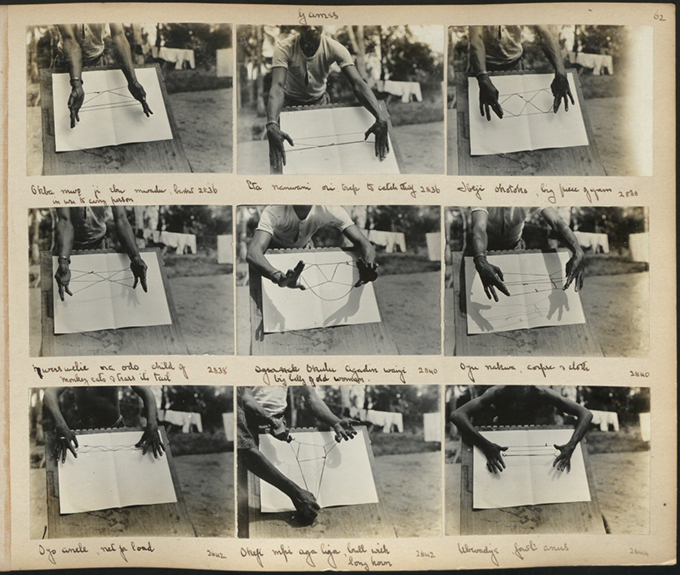
A photograph of a page from one of Northcote Thomas's photograph albums from his second and third tours in Southern Nigeria. The page features a 3x3 grid of nine black-and-white photographs depicting hands manipulating string to create various figurative configurations. These string figures, recorded in 1911, include designs such as 'Trap to catch thief', 'Basket spirits use to carry person', 'Big piece of yam', 'Child of monkey eats and tears its tail', 'Corpse and cloth', 'Big belly of old woman', 'Bull with long horn', 'Net for load', and 'Mask for juju'. The accompanying handwritten notations include both the English names and the local Igbo names, recorded in Thomas's idiosyncratic phonetic spelling. The image documents the cultural practice of akpukba, or string games, as practiced by the Igbo-speaking people in Agukwu Nri and Ebenebe.
Community Notes

Onyeka Nwokike
Oct 18, 2026
These photographs are among the earliest recorded images of African string figures, captured during Northcote Thomas's 1910 to 1911 survey of the Igbo-speaking people in the Awka District. While Thomas used the term akpukba, which literally means "to make or create something by hand," other known terms for these games include Ikpo ubo (playing strings), Gadas, and Atụmankasa, as detailed in Nigerian String Games - [Re:]Entanglements.
Onyeka Nwokike
Oct 18, 2026
Research conducted by Philip Noble and Yvonne Mbanefo provides specific cultural interpretations for the configurations. The "Basket spirits use to carry person" figure represents a palanquin, or sedan chair, used to transport chiefs, with the reference to "spirits" potentially linked to funeral customs involving palanquins borne by six men. The "Big piece of yam" figure utilizes diamond shapes to represent cubes of peeled yams of the genus Dioscorea. The "Trap to catch thief" configuration is a common West African design where a second player's finger is caught in a noose when the first player releases the loops.
Onyeka Nwokike
Oct 18, 2026
Many of the figures documented in this album appear across different African cultures. For example, the "Net for load" and "Bull with long horn" figures correspond to designs recorded in Yoruba-speaking areas and Ghana, respectively. The "Mask for juju" and "Corpse and cloth" figures also share identities with figures cataloged by other researchers, such as the "Moving Figure" and "Dead Man Lying on a Bed," according to Nigerian String Games - [Re:]Entanglements.
Log in to add context.
Explore Further
Discover related books and stories to deepen your understanding.

IGBO NAMES AND THEIR MEANING (MALE / FEMALE)
By Stanley Nwagwu

Anthropological Report on the Ibo-Speaking Peoples of Nigeria: Law and …
By Northcote Thomas

Anthropological Report On The Ibo-speaking Peoples Of Nigeria, Part 6 …
By Northcote Thomas

Anthropological Report on the Ibo-Speaking Peoples of Nigeria, Vol. 2: …
By Northcote Thomas

DIRT ON WHITE SPECTRUM: Myths, Travails and Legacies of Eze …
By Chukwuemeka Ifeanacho Onyesoh

African Cultures Before 21st Century: My Igbo Traditions
By Madueke Ebuka

Politics, Culture, and Origins in Nigeria: The Igbo and Their …
By Nwankwo Nwaezeigwe

IGBO NEW YAM FESTIVAL: The Secrets, Mysteries, Origins, and Significance …
By Mmesoma Uyaemesi

Art of Eastern Nigeria
By G.I. Jones
Aba and British Rule
By Dandy Ahuruonye
Drums, Dust, and Departure: Cultural Meanings of Death among the …
By Dandy Ahaoma Ahuruonye
You May Also Like
Obugulu Mau Masqueraders in Performance
By G.I. Jones
Igbo Yam Barn with Male Figure
Ogbugulu Mau Mask
By G.I. Jones
Speech by Chief Onyeso of Agukwu Nri
By Northcote Thomas
Painted Courthouse Mural at Nri
By Edward Harland Duckworth
Exhibition Stall of Local Produce
Dancer Wearing Fish Mask
By G.I. Jones

Portraits of an Igbo Woman in Oweri Province
By Northcote Thomas
Group Portrait of Titled Igbo Men
No comments yet. Be the first to share your thoughts!