

Family Group Portrait
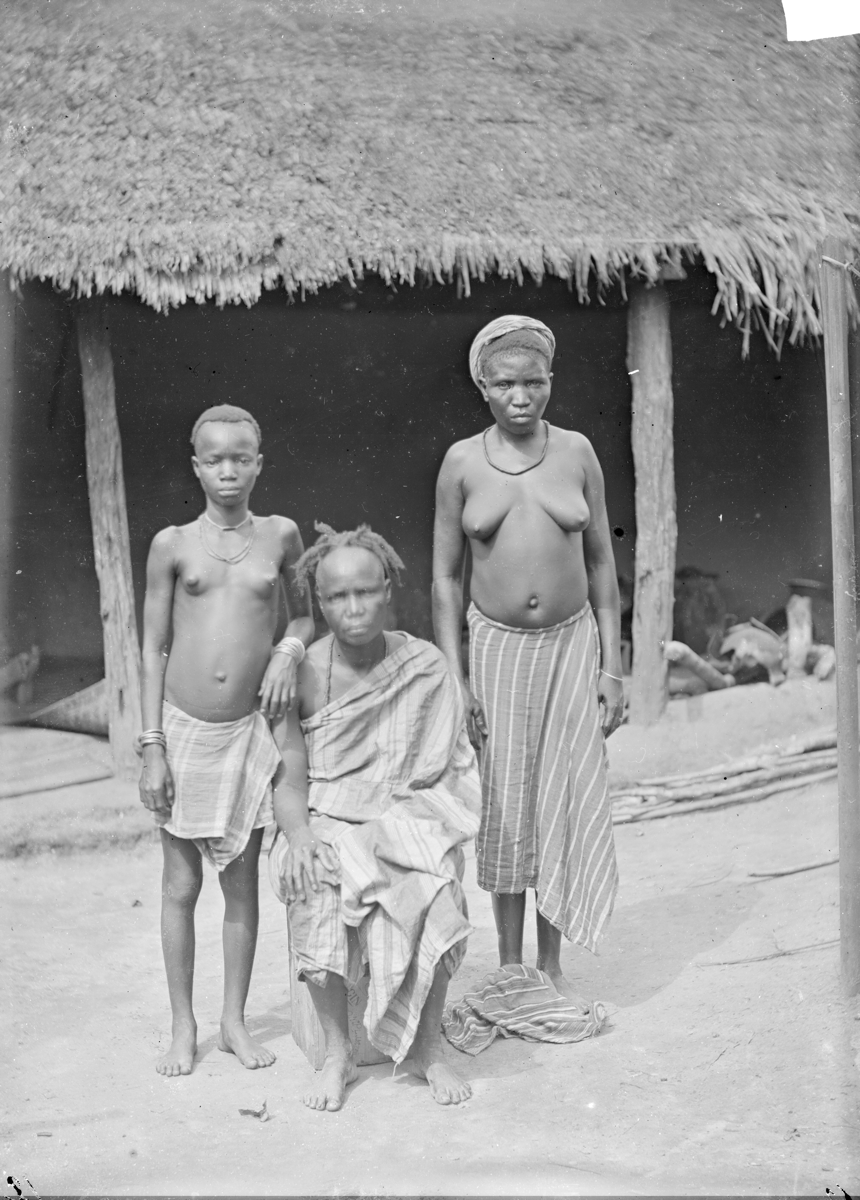
A photograph depicting a family group of three females positioned in front of an open-fronted structure with a thick thatched roof supported by unrefined wooden poles. The group consists of an adult woman seated in the center, wearing a large light-colored textile with prominent vertical stripes covering her torso and wrapping around her lower body, and two other females standing on either side. The female on the left is an adolescent or child with a bare upper torso and a striped loincloth, adorned with multiple thin necklaces and bracelets. The female on the right is an adult with a bare upper torso, wearing a long striped textile wrap around her hips and a large light-colored headwrap. All subjects wear circular necklaces and bracelets, utilizing woven fabrics characterized by repetitive parallel vertical stripes. The image is from the Crosse Collection, captured during the work of the Royal Niger Company between 1886 and 1895.
Community Notes

Onyeka Nwokike
Oct 18, 2026
This photograph is part of a broader collection used in the 1900 publication Nigeria: Our Latest Protectorate by Rev. Charles Henry Robinson. Robinson noted in his preface that he was indebted to Dr. W. H. Crosse for the loan of many photographs taken during his time as a Medical Officer for the Royal Niger Company.
Onyeka Nwokike
Oct 18, 2026
The subjects are likely from the Western Igbo (Anioma) or Northern Igbo riverine communities, specifically those around Onitsha (Onicha) and Asaba (Ahaba). Asaba served as the judicial and administrative headquarters for the Royal Niger Company during its royal charter period (1886 to 1899). Crosse's role as Principal Medical Officer provided him with unique access to these local communities during the company's colonial-commercial expansion.
Onyeka Nwokike
Oct 18, 2026
The striped woven textiles seen here were characteristic of the 19th-century weaving traditions of the Niger River area, often produced on local vertical looms. The circular neck rings, or igba, were typically made of brass or copper and served as markers of marital stage or social status for women. The hairstyle of the seated woman, featuring upright tufts or knots, is a traditional Igbo style prevalent in the late 19th century, as described in the Igbo Archives.
Log in to add context.
Explore Further
Discover related books and stories to deepen your understanding.

Trade Winds on the Niger: Saga of the Royal Niger …
By Geoffrey L. Baker

The Thing Around Your Neck
By Chimamanda Ngozi Adichie

The Igbo and their neighbours
By A. E. Afigbo

The Rise of British Colonialism in Southern Nigeria, 1700-1900: A …
By Kalu E. Ume

Igbo Art And Culture: And Other Essays
By Simon Ottenberg
Male Daughters, Female Husbands: Gender and Sex in an African …
By Ifi Amadiume

The Gospel on the Banks of the Niger: Journals and …
By Samuel Crowther and John Christopher Taylor

The Death of Vivek Oji
By Akwaeke Emezi

An Introduction to Nigerian Traditional Architecture: South-Eastern Nigeria: The Igbo-speaking …
By Z.R. Dmochowski
You May Also Like
Igbo Palm Wine Tapper
Portrait of an Igbo Man with Ichi Markings
By Northcote Thomas
Rural Scene with Igbo Masquerades
Ofo, Uxurhe, and Ikenga from North Ika
By G.I. Jones
African Priest and Altar Boys at a Christian Church
By William Henry Crosse
Igbo Elder in Knit Hat Portrait
By G.I. Jones
Obugulu Mau Masqueraders at Amobia Village
By G.I. Jones
Young Igbo Girl Painted with Uli
By Sylvia Leith-Ross
An Igbo Elder from Awka, Wearing a War Helmet and …
By Northcote Thomas
No comments yet. Be the first to share your thoughts!